




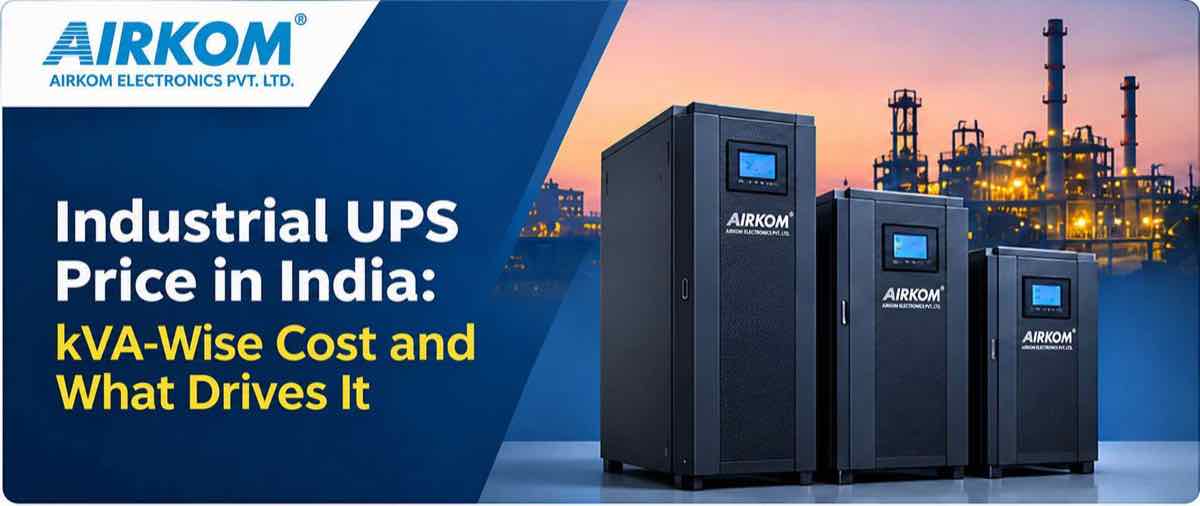
An industrial UPS price is more than its kVA: the battery bank, installation and AMC can match or exceed the UPS itself. kVA-wise bands, a cost breakdown and a like-for-like quote checklist.
In this articleShow
Short answer: The price of an industrial (3 phase online) UPS in India depends on more than its kVA. The battery bank, which is set by your backup time, often costs as much as the UPS or more. Installation, cabling and 5 years of AMC add a lot on top. Compare total cost, not the price of the UPS unit alone. The 3 phase online UPS price on a quotation is only one part of the bill.
If you have collected three quotations for "a 40 kVA UPS" and they look nothing alike, you are not alone. One includes batteries for 15 minutes, another for an hour. One includes the battery rack and cabling, another excludes them. One is 3:3 with a built-in isolation transformer, another is transformerless 3:1. On paper they are the same product. In practice they are not.
This guide gives kVA-wise price bands, breaks the total cost into its parts, and shows how to compare quotes like for like. It is written for plant owners, purchase managers and project consultants preparing a budget.
Industrial UPS price table (10 kVA to 400 kVA)
| Rating (3 phase online UPS) | Typical use | UPS unit only | With battery bank (15 min backup) |
|---|---|---|---|
| 10 kVA | Small server room, PLC / SCADA panel, small lab | On request | On request |
| 20 kVA | Office floor, computer lab, process control room | On request | On request |
| 40 kVA | Small factory critical loads, small hospital | On request | On request |
| 60 kVA | Medium plant automation, data room | On request | On request |
| 100 kVA | Production lines, hospital critical loads | On request | On request |
| 200 kVA | Large plant, data centre | On request | On request |
| 400 kVA | Whole-facility critical power | On request | On request |
Prices vary with backup time, battery type, configuration (3:1 or 3:3), installation scope and site location. That holds whether you are pricing a 20 kVA unit for a control room or checking a 60 kVA UPS price for a production line. For an exact figure, send your load and backup requirement for a written quote.
What makes up the total cost of an industrial UPS
Think of an industrial UPS system project as four cost blocks. Most quote confusion comes from vendors including different blocks.
1. The UPS unit (topology, 3:1 vs 3:3, efficiency)
- Topology. Industrial loads need online double conversion, where the load always runs on the inverter with zero transfer time. Offline and line-interactive units are cheaper but not suitable for industrial or critical loads.
- 3:1 vs 3:3. A 3:1 UPS (three phase in, single phase out) suits single-phase loads up to about 40 kVA. Above that, or for any 3 phase load, a 3:3 UPS is needed and costs more per kVA. Airkom's HX3 and i-HX3 3:3 series cover 10–400 kVA.
- Isolation transformer. A UPS with a built-in isolation transformer, like the HX3, costs more and weighs more than a transformerless one. In return it gives galvanic isolation, better handling of unbalanced loads and a cleaner neutral, which matter in factories with poor earthing.
- Efficiency. A UPS runs 24/7, so a few percent of efficiency is real money over 10 years. The HX3 series lists inverter efficiency up to 93% above 30 kVA.
- Redundancy. N+1 parallel configuration (two units sharing the load) costs more but removes the single point of failure. The HX3 supports N+1 parallel redundancy.
2. Battery bank: backup time, SMF vs lithium
This is where budgets go wrong, because UPS battery cost is easy to underestimate. Backup time drives the battery bank, and the battery bank can match or exceed the cost of the UPS itself.
- Backup time. 15 minutes (enough for DG changeover or safe shutdown) needs a modest bank. One hour needs roughly four times the energy. Every extra minute adds battery cost, almost in a straight line.
- SMF (VRLA). Lower upfront cost, but heavier and larger, and more sensitive to room temperature. Typically replaced several times over the UPS's life.
- Lithium (LiFePO4). Higher upfront cost, but compact, longer-lasting and faster to recharge. Over a 10-year horizon it often costs less in total because you avoid replacement cycles.
Our advice: do not buy one hour of battery backup if your DG set starts in 30 seconds. Right-size backup to what you really need: DG changeover plus safe shutdown time, plus a margin. See SMF Battery and Lithium Battery options.
3. Installation, cabling and battery rack
- Input and output cables (often specified as "by customer" in quotes, so check)
- Battery rack or cabinet, battery interconnects and DC breaker
- Input/output distribution panel and bypass arrangement
- Floor preparation, ventilation or AC for the UPS and battery room
- Installation, testing and commissioning charges
On a large project these can be a significant share of the total, so ask every vendor for an itemised scope.
4. AMC over 5 years
An industrial UPS is a 10–15 year asset. Budget for annual maintenance after the warranty, including preventive visits, fan and capacitor checks, battery health tests and breakdown response. Ask for 5-year AMC pricing upfront and add it to your total. Airkom offers Comprehensive AMC and Semi Comprehensive AMC plans.
Budgeting now? Tell us your load (kVA or kW), backup time and city, and we will send an itemised quote with UPS, batteries, installation and AMC shown separately. View HX3 Series 3:3 (10–400 kVA) or request a price.
How to compare two UPS quotes like for like
When comparing industrial UPS manufacturers in India, ask each for the same itemised breakdown, then put every quote into this checklist before comparing prices:
| Check | Quote A | Quote B |
|---|---|---|
| kVA and kW rating (output power factor) | ||
| Topology: online double conversion? | ||
| Configuration: 3:1 or 3:3 | ||
| Built-in isolation transformer: yes / no | ||
| Inverter efficiency at your load | ||
| Backup time at your actual load | ||
| Battery type, make, AH and number of cells | ||
| Battery rack, cables and DC breaker included? | ||
| Installation and commissioning included? | ||
| Warranty on UPS and on batteries (separately) | ||
| 5-year AMC cost | ||
| Service response time in your city |
The most common trick is backup time quoted at a lower load than yours. "30 minutes backup" at 50% load is closer to 12–15 minutes at full load. Always ask for backup at your load.
Ways to reduce cost without adding risk
- Right-size the kVA. Put only critical loads on the UPS (controls, PLCs, servers, sensitive machines), not lighting and HVAC. Use our UPS kVA sizing guide to calculate the real requirement.
- Right-size the backup. Match battery backup to your DG changeover and shutdown needs, not a round number.
- Plan modular growth. Buy for today's load plus 20–25%, and use parallel capability to add a second unit later rather than buying a much larger unit now.
- Consider lithium on a 10-year view. Higher upfront, but fewer replacements.
- Rent for short projects. For temporary sites, events, commissioning periods or while a new unit is on order, renting avoids capital expenditure. See Airkom's rental and lease options.
- Fix voltage problems upstream. If the real problem is voltage fluctuation rather than outages, a servo stabilizer may protect large loads at a fraction of UPS cost, leaving the UPS for loads that truly need backup.
Get an itemised industrial UPS quote
Airkom manufactures 3 phase online UPS systems from 10 kVA to 400 kVA at Mahape, Navi Mumbai. Send us your load, backup time and site location. We will send an itemised quote that separates the UPS, battery bank, installation and AMC, so you can compare it fairly with any other.
HX3 Series 3:3 (10–400 kVA) → | i-HX3 Series 3:3 | Rental & Lease | Request a price →
Frequently asked questions
What is the price of a 20 kVA online UPS in India?
A 20 kVA online UPS price depends on configuration (3:1 or 3:3), whether it has a built-in isolation transformer, and especially the battery backup time and battery type. Airkom shares current price bands on request. For an exact figure, share your load and backup time for an itemised quote.
Why is the battery bank sometimes costlier than the UPS?
Backup time is delivered entirely by the batteries. The UPS electronics cost roughly the same whether you need 10 minutes or 2 hours of backup, but the battery bank grows almost in proportion to backup time. For backup of 30 minutes or more, the battery bank often costs as much as the UPS, or more.
Is lithium battery worth it for an industrial UPS?
Often, yes, over a 10-year horizon. Lithium (LiFePO4) costs more upfront but lasts longer, takes less space, tolerates heat better and recharges faster. This reduces replacement cycles and battery room costs. For short backup in an air-conditioned room with a tight budget, SMF batteries can still make sense.
Can I rent or lease an industrial UPS?
Yes. Airkom offers rental and lease options for UPS systems and stabilizers. These suit temporary sites, short projects, commissioning periods, or bridging the gap until a purchased unit is delivered.
How much does AMC cost for an industrial UPS?
AMC cost depends on the UPS rating, whether batteries are included, and comprehensive vs semi-comprehensive cover. Ask for 5-year AMC pricing with the purchase quote and include it in your total cost comparison.
Should I choose a 3:1 or 3:3 industrial UPS?
Choose 3:1 for single-phase loads up to about 40 kVA in a building with 3 phase supply. Choose 3:3 for any 3 phase load, for larger ratings, or for server rooms and plants. 3:3 costs more per kVA but is the standard for industrial installations.

Engineers at Airkom Electronics, makers of servo stabilizers, online UPS systems and power transformers at our plant in Mahape, Navi Mumbai. ISO 9001 and ISO 14001 certified.