




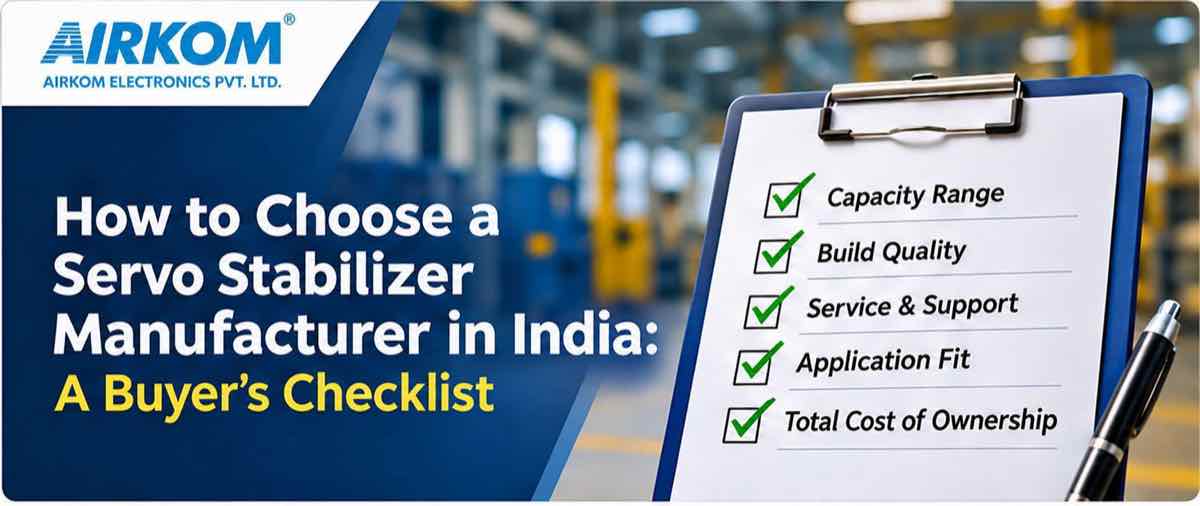
The best servo stabilizer company for you is a real manufacturer that uses copper windings, corrects unbalanced loads, tests every unit and services your city. A fair 10-point checklist plus RFQ questions and quotation red flags.
In this articleShow
Short answer: There is no single "best" servo stabilizer company for every buyer. The best one for you is a genuine manufacturer, not a trader, that uses copper windings, corrects unbalanced loads, tests every unit before dispatch, holds verifiable certifications, and has service engineers in your city. Use the 10-point checklist below to score each vendor on your shortlist.
Search "best servo stabilizer company in India" and you will find lists ranking the best servo stabilizer brand in India, usually written by one of the brands on the list. We won't do that. Airkom is a servo stabilizer manufacturer, so a ranking from us would be biased, and you would be right to ignore it.
Instead, this is the checklist our own engineers would use if they were buying a stabilizer from someone else. It is written for purchase managers, EPC contractors, consultants and plant heads comparing three or four vendors before raising an RFQ. Under each point we show briefly how Airkom meets it, so you can hold us to the same standard.
The 10-point checklist at a glance
| # | Check | What a good answer looks like | Red flag |
|---|---|---|---|
| 1 | Copper winding & transformer quality | Winding material stated in writing | "Standard winding" with no material named |
| 2 | Correction speed & input range | V/sec and input range on the datasheet | Only "fast correction" |
| 3 | Balanced vs unbalanced correction | Independent phase correction for 3 phase | Balanced type offered for factory loads |
| 4 | Protections | OV/UV, overload, short circuit, single phasing, bypass | Protections listed as "optional extras" |
| 5 | Factory testing | Test report with each unit | No test certificate offered |
| 6 | Certifications | Certificates you can verify | Logos with no certificate copies |
| 7 | Capacity range & custom builds | Your rating is in the regular range | Your rating is "special order" from a trader |
| 8 | Warranty | Clear terms, in writing | Vague or "as per company policy" |
| 9 | AMC & service in your city | Named service contact and response commitment | Service "through dealer" |
| 10 | References in your industry | Contactable users with similar loads | No references offered |
Manufacturer vs trader / assembler: why it matters
Many companies that present themselves as a servo stabilizer manufacturer in India do not actually make the product. They buy kits or finished units, apply their own label and resell. That is not automatically bad, but it matters in three situations:
- Warranty claims. A trader has to go back to their supplier. Claims take longer and the trader has less control over the outcome.
- Spares. Carbon brushes, servo motors, control cards and variacs need to be available years later. A manufacturer controls this; a trader may have switched suppliers twice since your purchase.
- Custom ratings. If you need an unusual input range or a 600 kVA unit, a manufacturer designs it. A trader can only sell what their supplier builds.
How to check: ask to visit the factory, or ask for photos of the winding and test areas. A manufacturer will usually welcome the visit. Airkom designs and manufactures its servo stabilizers, static stabilizers, transformers and UPS systems at its own facility in Mahape, Navi Mumbai.
The 10-point buyer checklist
1. Copper winding and transformer quality
The buck-boost transformer and variac are the heart of a servo stabilizer. Copper windings run cooler, handle overloads better and last longer than aluminium. Some low quotes save money here, so ask for the winding material, the transformer's temperature rise and the core material in writing. Also check whether construction follows a recognised standard. Airkom's 3 phase servo stabilizers are built as per IS 9815 Part II / IS 2026.
2. Correction speed and input voltage range
Correction speed (volts per second) tells you how quickly the stabilizer brings voltage back during a dip or surge. The input range tells you how bad the supply can get before it gives up. Ask for both on the datasheet, and match the input range to your site. An industrial estate with deep evening sags needs a wide-range model. Airkom 3 phase servo: average correction speed 70 V/sec (line to line) with zero hunting, response time under 10 ms, ±1% output regulation, and normal, wide, extra-wide and custom input range options.
3. Balanced vs unbalanced load correction
In real factories, buildings and hospitals, the three phases are never equally loaded, and the grid voltage on each phase also differs. A balanced type stabilizer corrects all three phases together based on an average. That can push a lightly loaded phase into overvoltage. An unbalanced type corrects each phase independently. For almost every commercial and industrial site you want unbalanced. Airkom's TPAC series is designed for 100% unbalanced load and input voltage conditions.
4. Protection: OV/UV, overload, short circuit, bypass
The stabilizer must protect your equipment when the supply goes beyond what it can correct. Check for:
- Over-voltage and under-voltage output cut-off
- Electronic overload trip with time delay
- Short-circuit protection
- Single-phasing prevention
- Phase-reversal protection
- Bypass switch for maintenance
- Output ON time delay after power restoration
Airkom 3 phase servo: all of the above, with overload cut-off above 110% of rated current with graded time delay, bypass standard up to 45 kVA (optional above), and a 15-second output delay settable to 3 minutes.
5. Factory testing before dispatch
Ask what tests every unit goes through before it leaves the factory: load test, regulation test, protection trip tests and insulation test. Ask for a sample test report. A manufacturer who tests every unit will have a standard format ready. Airkom states that every new model is evaluated, tested and refined for more than a year before release. Ask us for the routine test report format for your unit.
6. Certifications (verify them)
Certifications show that a company's quality processes have been independently audited. Ask for copies and check the certificate number and validity with the issuing body. Logos on a brochure are not proof. Airkom's listed certifications include ISO 9001:2015, ISO 14001:2015, ISO 45001:2018, CE, NABL, STQC, MSME, GeM / RITES, Intertek IEC 62040-1 and TUV. See the full list on our certifications page.
7. Capacity range and custom builds
A manufacturer whose regular range comfortably covers your rating has built many units like yours. Also ask whether they can build a custom input range, voltage or enclosure if your site needs it. Airkom servo stabilizers: 1–20 kVA single phase, 10–400 kVA three phase air cooled, and up to 3 MVA oil cooled, with custom input ranges available.
8. Warranty terms
Read the warranty clause in the quotation, not the brochure. Check the duration, what is covered (parts, labour, travel), what is excluded (carbon brushes are often treated as consumables), and how a claim is raised. Airkom servo and static stabilizers carry a 1-year "No Questions Asked" guarantee.
9. AMC and service network in your city
A stabilizer runs for 15 years or more if it is maintained. Ask who will service it in your city, how quickly they respond to a breakdown, and what an AMC includes. This matters more than a small price difference at purchase. Airkom has an all-India sales and support network and offers Comprehensive AMC, Semi Comprehensive AMC and on-call service, with a base in Navi Mumbai serving Mumbai, Thane, Pune and the rest of Maharashtra.
10. References in your industry
A textile mill, a hospital and a CNC shop all stress a stabilizer differently. Ask for two or three references in your own industry with similar ratings, and call them. Ask how the unit has performed and how service has been. Airkom supplies textile mills, machine tools, telecom, medical and IT installations. Ask us for references relevant to your sector.
Shortlisting now? Send us your load details and we will answer every point above in writing with our quotation. See Airkom's servo stabilizer range or request a quote.
Questions to ask in your RFQ (copy and paste)
- Are you the manufacturer of this stabilizer? Where is it manufactured?
- What is the winding material of the buck-boost transformer and variac?
- Is the unit balanced or unbalanced type (independent phase correction)?
- What is the input voltage range and output regulation (± %)?
- What is the average correction speed (V/sec) and response time?
- List all protections included as standard.
- Is a bypass switch included? Is it manual or automatic?
- What is the efficiency at full load?
- Cooling: air or oil? What is the rated ambient temperature?
- What tests are done on every unit before dispatch? Will a test report be provided?
- Please share copies of your quality and product certifications.
- What is the warranty period and what does it exclude?
- Who will provide service in our city, and what is the breakdown response time?
- What are the AMC options and annual charges?
- Please share two references with similar ratings in our industry.
- What is the delivery time, and are installation and commissioning included?
Red flags in a quotation
- No winding material mentioned. Assume aluminium until told otherwise.
- A rating far smaller than the competition for the same load. Someone has undersized to win on price.
- Input range not stated, or a narrow range offered for a site you know has bad voltage.
- "Balanced type" offered for a factory or commercial building.
- Bypass, overload trip or single-phasing protection listed as extras.
- No test report, no certificates on request.
- Warranty "as per company policy" with no written terms.
- Service "through our dealer" with no named contact in your city.
- A price far below every other quote. Something is missing from it.
Our honest advice
Do not decide on price alone, and do not decide on brand name alone. Shortlist three of the best servo stabilizer manufacturers in India for your load, send them the same RFQ with your actual load data, and compare the answers line by line. The vendor who answers every question clearly and in writing is usually the one who will also answer the phone when something goes wrong in year six.
If you need a voltage stabilizer manufacturer in Mumbai, or one of the servo stabilizer manufacturers in Maharashtra with local service, Airkom is happy to be on that shortlist. We manufacture at Mahape, Navi Mumbai, and we will answer every point above in our quotation.
View the Airkom servo stabilizer range → | About Airkom | Certifications | Send your RFQ →
Frequently asked questions
Which is the best servo stabilizer company in India?
The best company for you is one that manufactures its own stabilizers, uses copper windings, offers independent phase (unbalanced) correction, tests every unit, holds verifiable certifications and has service support in your city. Use a checklist to compare three or four manufacturers on the same RFQ rather than relying on online rankings.
Is copper winding better than aluminium in a servo stabilizer?
Yes. Copper has lower resistance than aluminium, so copper windings run cooler, handle overloads and inrush currents better, and generally last longer. Aluminium-wound units can cost less upfront but tend to run hotter. Always ask for the winding material in writing.
What warranty should a servo stabilizer manufacturer give?
A reputable manufacturer should give at least a 1-year warranty with clear written terms covering parts and labour, and should state what is excluded (carbon brushes are often consumables). Airkom offers a 1-year "No Questions Asked" guarantee on its stabilizers. Also look at AMC options for the years after warranty.
Are there servo stabilizer manufacturers in Mumbai with AMC support?
Yes. Airkom manufactures servo stabilizers at Mahape, Navi Mumbai, and offers comprehensive, semi-comprehensive and on-call service plans for customers in Mumbai, Thane, Navi Mumbai, Pune and across Maharashtra, backed by an all-India support network.
How do I know if a stabilizer seller is a manufacturer or a trader?
Ask where the unit is manufactured and request a factory visit or photos of the winding and testing areas. Ask whether they can build a custom input range or rating. Manufacturers can usually show their production and testing set-up and design to your specifications; traders typically cannot.
What should a servo stabilizer quotation include?
It should state the kVA rating, input voltage range, output regulation, correction speed, winding material, balanced or unbalanced type, cooling, all protections, bypass, efficiency, warranty terms, testing, delivery time, installation scope and AMC options. If any of these are missing, ask before comparing prices.

Engineers at Airkom Electronics, makers of servo stabilizers, online UPS systems and power transformers at our plant in Mahape, Navi Mumbai. ISO 9001 and ISO 14001 certified.