





Servo Voltage Stabilizer vs. Static Voltage Stabilizer: Engineering Guide for CNC & Industrial Machinery
Compare motor-driven servo voltage stabilizers and solid-state static stabilizers across correction speed, voltage accuracy, maintenance, and CNC machinery protection.

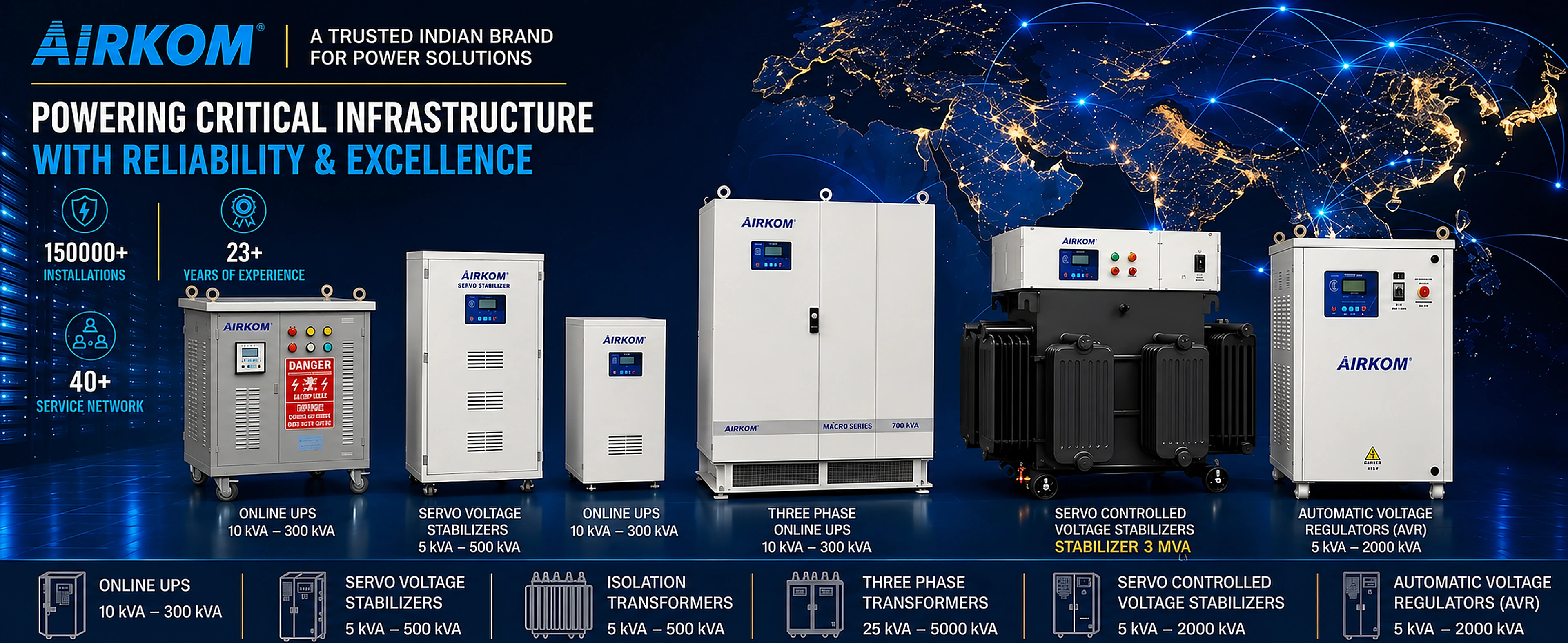
Industrial plant managers and chief electrical engineers regularly face an expensive dilemma: automated machine tools, CNC milling centers, robotics, and automated production cells are increasingly intolerant of grid voltage instability. Even a brief 10% voltage sag or continuous 15% voltage surge can trip variable-frequency drives (VFDs), ruin high-precision machining tolerances, or cause catastrophic control-board burnouts.
When selecting a centralized or dedicated voltage stabilization solution, the two primary contenders are Servo Voltage Stabilizers (SCVS) and Solid-State Static Voltage Stabilizers (SVS). While both serve to regulate incoming utility fluctuations, their underlying physics, response dynamics, and lifecycle economics differ dramatically.
1. Operating Principles: Electromechanical vs. Solid-State
The Servo Voltage Stabilizer (SCVS)
A Servo Voltage Stabilizer operates on an electromechanical principle. It consists of:
- A servo motor mechanically coupled to a carbon brush assembly.
- A toroidal continuously variable autotransformer (Variac).
- A heavy-duty Buck-Boost Transformer (BBT).
- An electronic sensing circuit and microcontroller.
When the grid voltage rises or drops, the sensing circuit commands the servo motor to rotate clockwise or counter-clockwise across the variac winding. This mechanically adjusts the primary voltage of the buck-boost transformer, adding (boosting) or subtracting (bucking) voltage in series with the load to restore output to nominal (e.g., 415V 3-Phase).
The Static Voltage Stabilizer (SVS)
A Static Voltage Stabilizer contains zero moving parts. Instead of a motor and carbon brush, it uses high-speed solid-state power electronic semiconductors—typically IGBTs (Insulated Gate Bipolar Transistors) or SCRs (Silicon Controlled Rectifiers)—controlled by a high-speed Digital Signal Processor (DSP).
The DSP continuously samples incoming AC waveform at kHz frequencies. When voltage swings occur, the microprocessor switches the solid-state taps or synthesizes a compensating voltage vector into the buck-boost transformer within a fraction of an electrical cycle (sub-cycle response).
2. Technical Comparison Matrix
| Engineering Metric | Servo Voltage Stabilizer (SCVS) | Static Voltage Stabilizer (SVS) |
|---|---|---|
| Technology | Electromechanical (Motor + Brush + Variac) | 100% Solid-State (IGBT / SCR / DSP) |
| Correction Speed | 35V to 105V / second (takes 200ms–800ms) | Sub-cycle (< 20 milliseconds) |
| Output Voltage Accuracy | ± 0.5% to ± 1.0% | ± 1.0% |
| Moving Parts | Yes (Motor, gears, carbon brushes) | Zero moving parts |
| Audible Noise & Sparks | Mechanical motor hum, minor brush sparking | Completely silent, zero sparking |
| Maintenance Requirements | Periodic brush inspection & variac cleaning | Virtually maintenance-free |
| Capacity Range | 1 kVA up to 3,000 kVA (Air & Oil Cooled) | 1 kVA up to 300 kVA (Air Cooled) |
| Capital Cost per kVA | Highly economical, especially at >100 kVA | Higher initial investment |
| Lifespan | 15–20+ years (with periodic servicing) | 15+ years |
3. Deep-Dive: When to Choose a Static Voltage Stabilizer
The defining advantage of a static stabilizer is correction speed. In modern industrial facilities, voltage disturbances often occur as rapid, sub-second sags caused by neighboring arc furnaces, heavy compressor startups, or grid switching events.
Recommended Applications for Static Stabilizers:
- High-Precision CNC Machining Centers: Modern CNC drives monitor DC bus voltage continuously. If a voltage sag lasts longer than 20–30 milliseconds, the drive faults out, stopping the spindle mid-cut and scrapping an expensive workpiece. A static stabilizer corrects the sag in under 20ms, preventing the drive from tripping.
- SMT Electronics Assembly & Robotics: Pick-and-place robotics and optical inspection machines have tight bus tolerances that cannot wait for a mechanical motor to travel.
- Medical Imaging (MRI, CT Scanners): Requires silent operation, zero carbon brush dust, and absolute instantaneous waveform recovery.
- Data Centers & Industrial Server Racks: Zero electrical noise and immediate transient isolation.
👉 Explore Airkom's Power Quality Management & Static Stabilizer Series.
4. Deep-Dive: When to Choose a Servo Voltage Stabilizer
Despite the speed advantage of static stabilizers, Servo Voltage Stabilizers remain the dominant workhorse of industrial manufacturing across Asia. The reasons are rooted in ruggedness, overload capacity, and capital efficiency:
Recommended Applications for Servo Stabilizers:
- High-kVA Whole-Plant Main Incomer Stabilization (300 kVA to 3,000 kVA): In massive textile mills, steel plants, chemical processing facilities, and automotive assembly lines, total power demands exceed 500 kVA. Building solid-state static stabilizers at multi-MVA capacities becomes cost-prohibitive. Oil-cooled servo stabilizers handle thousands of kVA reliably and economically.
- High Inrush Inductive Loads: Heavy AC motors, hydraulic presses, and refrigeration compressors draw 3x to 6x starting currents. The massive copper mass of a servo stabilizer’s buck-boost transformer absorbs enormous short-term thermal overloads without semiconductor breakdown.
- Severe Environmental Conditions (Dust, Moisture, Heat): Oil-immersed servo stabilizers hermetically seal all windings and moving parts in dielectric mineral oil, operating uninterrupted in ambient temperatures up to 50°C and dusty foundry environments.
👉 Explore Airkom's Servo Voltage Stabilizer Range (1-Phase & 3-Phase Air/Oil Cooled).
5. Engineering Sizing Formula for Industrial Loads
Required Stabilizer kVA = [Total Connected Load (kW) ÷ Power Factor] × 1.25 Safety Margin + Peak Inrush Headroom- Power Factor: Typically 0.8 for mixed industrial inductive loads.
- Safety Factor: Standard 25% margin ensures long life and allows future plant expansion.
- Input Window Matching: If utility voltage regularly drops to 320V line-to-line, ensure the stabilizer input range is specified as Wide Range (300V – 470V) rather than Normal Range (360V – 460V).
Conclusion & Recommendation
For high-speed, microsecond-sensitive tooling where a 100ms voltage sag causes expensive scrap or drive failure, specify an Airkom Static Voltage Stabilizer. For heavy whole-plant protection, large motor loads, and capacities from 100 kVA to 3,000 kVA, the rugged Airkom Servo Voltage Stabilizer delivers superior return on investment and decades of service.
Need assistance sizing your plant's voltage regulation system? Schedule a complimentary electrical load consultation with Airkom engineers or call our application engineering desk at Mahape, Navi Mumbai.
Require Custom Sizing or Technical Specifications?
Airkom engineers provide complimentary load audits, harmonic calculations, and customized power protection proposals for manufacturing facilities.
Manufacturing precision servo stabilizers, online UPS systems, and power transformers since inception. Certified ISO 9001, ISO 14001, CE marked, and approved by NABL, STQC, and GeM. Plant located at Mahape, Navi Mumbai.