




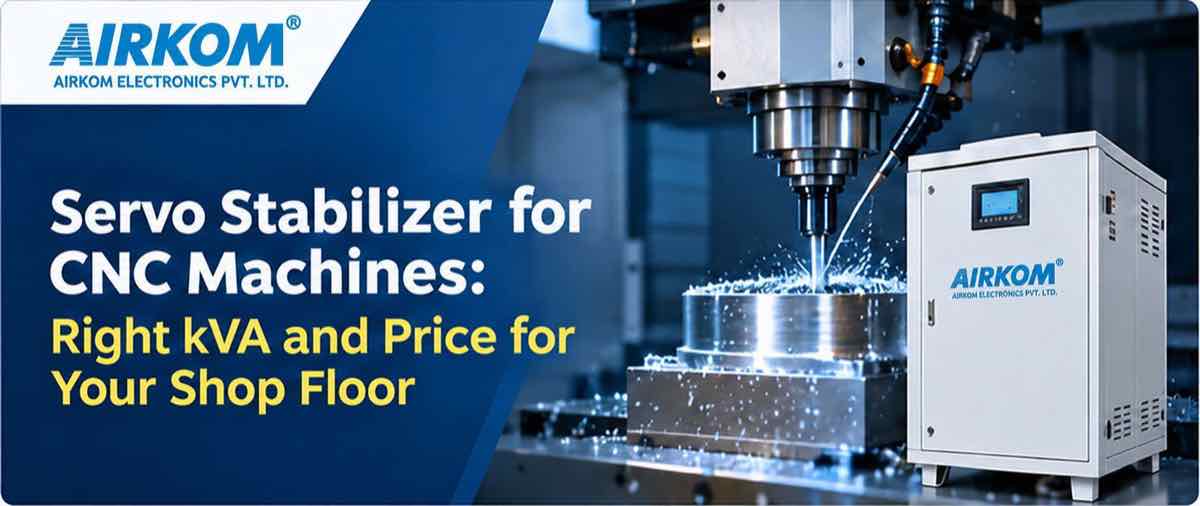
Most CNC machines need a 3 phase servo stabilizer of about 1.5x the machine kVA. A 10 kW CNC lathe needs roughly 20 kVA. Here is the sizing table, central vs per-machine logic, and what drives the price.
In this articleShow
- Quick sizing table: CNC machine type vs suggested stabilizer kVA
- Why you need a servo stabilizer for CNC machines
- How to calculate the kVA for your CNC machine
- One central stabilizer vs one stabilizer per machine
- Air cooled or oil cooled for a CNC shop?
- Features to insist on in a CNC stabilizer
- Stabilizer for CNC machine price: what changes the cost
- When you also need an isolation transformer
- Next step: get the right rating for your shop
- Frequently asked questions
Short answer: For most shops, the best stabilizer for CNC machine protection is a 3 phase air cooled servo stabilizer rated at about 1.5 times the machine's kVA (machine kW ÷ 0.8). A 10 kW CNC lathe needs about a 20 kVA stabilizer. A single 50–150 kVA stabilizer for the whole shed usually costs less than one stabilizer per machine, provided the cabling allows it.
Most CNC breakdowns that get blamed on "bad electricity" come down to one thing: the incoming voltage left the band the controller and spindle drive were built for. MIDC and industrial-belt supply often sags to 360–370 V at the end of a shift and jumps above 440 V at night or on Sundays when nearby loads switch off. Your CNC does not care why. It just throws an alarm, drops the program, or quietly cooks a drive card.
This guide answers one question: "My CNC machine is X kW. Which stabilizer should I buy, and what kVA?" It covers the common cases, from a stabilizer for CNC turning machine set-ups to a stabilizer for CNC router machine installations. The sizing table comes first, followed by the decisions that change the price: one stabilizer or several, air or oil cooling, and which features are worth paying for.
Quick sizing table: CNC machine type vs suggested stabilizer kVA
Use this as a starting point. The exact figure depends on your machine's nameplate, which the next section explains how to read.
| Machine type | Typical connected load | Suggested servo stabilizer (3 phase) | Notes |
|---|---|---|---|
| Small CNC turning / lathe | 7.5 – 12 kW | 15 – 20 kVA | Spindle start is the main surge; 20 kVA leaves room |
| Mid-size CNC lathe / turn-mill | 15 – 25 kW | 30 – 45 kVA | Check if hydraulic chuck and coolant pump are on the same feeder |
| VMC (vertical machining centre) | 10 – 25 kW | 20 – 45 kVA | Tool changer and chiller add short peaks |
| HMC (horizontal machining centre) | 25 – 45 kW | 45 – 75 kVA | Pallet changer and high-torque spindle; size generously |
| CNC router (wood / ACP / stone) | 5 – 15 kW incl. dust collector | 10 – 25 kVA | Include the vacuum pump and dust extractor in the load |
| Fibre laser cutter | 15 – 40 kW incl. chiller & compressor | 30 – 75 kVA | Laser source is voltage-sensitive; chiller start is the surge |
| Whole shop (4–8 mixed CNCs) | Sum of running load | 75 – 200 kVA central unit | Apply a diversity factor; see the central vs per-machine section |
The ranges above are planning bands only. Two VMCs with the same table size can differ by 40% in connected load depending on spindle motor and options. Always confirm against the nameplate, or ask for a free site load audit and we will measure it.
Why you need a servo stabilizer for CNC machines
A CNC machine has three parts that react badly to unstable voltage:
- The controller (Fanuc, Siemens, Mitsubishi and others). Its internal power supply tolerates only a narrow band. Below that band it resets mid-cycle and you lose the program position. Above it, the SMPS and I/O cards take the stress.
- The spindle and servo drives. These are rectifier-based. Low voltage pushes current up to hold torque, which shows up as overcurrent or undervoltage alarms. High voltage raises the DC bus and trips overvoltage. Repeated high-voltage events are a common cause of failed drive capacitors and IGBT modules.
- Motors, pumps and the chiller. Running a motor at 10% under-voltage raises its current and temperature, which shortens winding life.
For the shop owner, the cost shows up as scrapped components when a cut is interrupted, spindle-drive repair bills, idle operators while the machine is re-homed, and late deliveries. One failed drive card often costs more than the stabilizer that would have prevented it.
Many CNC machines have an internal "AVR" or a tolerance of ±10%. That covers small dips. It does not cover a 15–20% low-voltage shift that lasts an hour, and it does not protect the coolant pump, hydraulic unit or chiller. A dedicated voltage stabilizer for CNC machine supply holds the output at ±1% of nominal for all of them.
How to calculate the kVA for your CNC machine
Step 1: Read the machine nameplate (kW, kVA and power factor)
Look at the electrical cabinet door or the machine manual. You will usually find one of these:
- Total connected load in kVA: the easiest case. Use it directly.
- Total connected load in kW: divide by the power factor. If the power factor is not printed, use 0.8. So 12 kW ÷ 0.8 = 15 kVA.
- Only motor ratings (spindle kW + axis kW + pump kW): add them all, then divide by 0.8.
- Only a current (amps) figure: kVA = 1.732 × 415 V × amps ÷ 1000. A machine drawing 30 A per phase is roughly 21.5 kVA.
Step 2: Add headroom for spindle start and future machines
Spindle acceleration draws a short burst above the running current. Most modern spindle drives soft-start, so the burst is modest, but chillers, compressors and hydraulic pumps on direct-on-line starters can pull 5–7 times their running current for a moment. A stabilizer running at 100% of its rating all day also runs hotter than one at 60–70%.
Our rule of thumb for CNC:
- Single machine: machine kVA × 1.3 to 1.5, rounded up to the next standard rating.
- Machine plus chiller or compressor on the same output: × 1.5, or more if the compressor is direct-on-line.
- Planned expansion within 2 years: add the new machine's kVA now. Upgrading later costs more than buying the right size once.
Worked example: 10 kW CNC turning machine
10 kW ÷ 0.8 = 12.5 kVA. Multiply by 1.5 and you get 18.75 kVA, so choose a 20 kVA 3 phase servo stabilizer. If the coolant chiller is fed from the same output, consider 25 kVA.
Not sure about your load? Send us the nameplate photo or the number of machines in your shed and Airkom's engineers will recommend the rating. See the 3 Phase Servo Stabilizer (Air Cooled), 10–400 kVA or request a quote and free site load audit.
One central stabilizer vs one stabilizer per machine
This is the decision that changes your budget most, and most shops get it wrong in one direction or the other.
| Factor | One central stabilizer for the shed | One stabilizer per machine |
|---|---|---|
| Total cost | Usually lower: you size for the real running load, not the sum of all nameplates | Higher: each unit carries its own headroom |
| Wiring | Needs a clean output distribution panel; existing feeders may need rerouting | Simple: install next to each machine |
| Floor space | One footprint, usually in the electrical room | A unit beside every machine |
| If it fails | Bypass keeps the shop running unprotected until repair | Only one machine affected |
| Best for | Shops with 4+ machines, new sheds, planned expansion | 1–3 machines, rented sheds, machines spread across bays |
Our view: once you have four or more CNCs on one incoming supply, a central 3 phase servo stabilizer is almost always the better buy. Not every machine runs at full load at the same time, so a diversity factor of 0.6–0.8 is usual. Six machines with 15 kVA nameplates each (90 kVA total) often run comfortably on a 75–100 kVA central unit. The exception is a shop where one machine (a laser, say) is far more sensitive or expensive than the rest. Give that machine its own unit and put the rest on the central stabilizer.
Air cooled or oil cooled for a CNC shop?
Airkom builds both:
- Air cooled servo stabilizer: 10 kVA to 400 kVA. Lighter, quicker to install, needs no oil handling. It is the right choice for the vast majority of CNC shops up to a few hundred kVA, provided the room is ventilated and not full of metal dust.
- Oil cooled servo stabilizer: 10 kVA up to 3 MVA. The windings are immersed in oil, which carries heat away far better than air. Choose it for high ambient temperatures, dusty or humid shop floors (foundries, forging and grinding sections), outdoor or semi-outdoor installation, and large central units above roughly 300–400 kVA.
A simple test: if your shop floor is above 40 °C in summer, or the machines are covered in fine dust by the end of the week, go oil cooled for the central unit.
Features to insist on in a CNC stabilizer
Not all servo stabilizers are equal. Before you sign a purchase order, check the datasheet for these. Here are Airkom's figures for the 3 phase air cooled range as a benchmark:
- Unbalanced load correction. In a CNC shop the three phases are rarely loaded equally. A balanced-type stabilizer corrects all three phases together and can push one phase out of limits. Insist on independent phase correction. Airkom's TPAC series is built for 100% unbalanced load and input voltage.
- Output regulation: ±1% of nominal output voltage.
- Correction speed: an average of 70 V/sec (line to line) on the 3 phase servo range, with zero hunting. Faster correction means less time outside the safe band during a sudden dip.
- Response time: less than 10 ms.
- Protections: electronic overload cut-off above 110% of rated current with graded time delay, plus single-phasing prevention, short-circuit protection and phase-reversal protection. Phase reversal matters on CNCs because a reversed phase sequence can run a pump or spindle cooler backwards.
- Output ON time delay: a delay (15 seconds as standard, settable to 3 minutes) so that when power returns after a cut, the machines restart only after the voltage has settled.
- Bypass switch: standard up to 45 kVA on Airkom units and optional above that. Always take it, because it lets you keep running during maintenance.
- Digital VAF meter: shows input and output voltage, current and frequency, so your maintenance team can see what the grid is doing.
- Input voltage range: pick the range to match your area. Airkom offers normal, wide, extra-wide and custom input ranges. In industrial estates with deep evening sags, a wide-range model is worth the small premium.
- Efficiency: better than 98%, so the stabilizer itself does not add much to your electricity bill.
Servo or static stabilizer for CNC?
A servo stabilizer is the standard, cost-effective choice for CNC machines and covers most shops well. A static (IGBT-based) stabilizer corrects almost instantly, at 4000 V/sec or more, and has no moving parts. Consider it for very sensitive machines such as fibre lasers, EDM or high-precision grinding, or where the supply has frequent fast flicker. For a detailed comparison, read our servo vs static stabilizer guide.
Stabilizer for CNC machine price: what changes the cost
The quotations you receive for a "20 kVA servo stabilizer" can differ a lot. These are the factors that legitimately move the price:
- kVA rating. The biggest driver. This is why correct sizing matters: oversizing by two steps can add a large share to the bill.
- Input voltage range. A wide-range unit (for example 270–480 V) needs a larger buck-boost transformer than a normal-range one, so it costs more.
- Cooling. Oil cooled units cost more at low ratings, but for large central units the gap narrows and the lifespan advantage often pays it back.
- Copper vs aluminium winding. Copper windings run cooler and handle overloads better. Cheaper quotes sometimes save money here, so ask for the winding material in writing.
- Balanced vs unbalanced type. Independent phase correction costs more, and CNC shops need it.
- Extras. Bypass above 45 kVA, an isolation transformer, surge protection, remote monitoring.
Current price bands: Airkom shares up-to-date kVA-wise prices on request because they depend on input range, cooling and options. Send your machine kW and city through our contact page or call +91 93238 63400 for a written quote.
When you compare quotes, compare like for like: same kVA, same input range, same winding material, same unbalanced correction, same warranty. A cheaper quote that is missing one of these is not actually cheaper.
When you also need an isolation transformer
A servo stabilizer fixes the level of the voltage. It does not fix:
- Neutral-to-earth voltage from poor earthing, which shows up as random controller faults and encoder errors.
- Electrical noise and harmonics from other drives, welding machines or induction furnaces on the same feeder.
If your CNC throws communication or encoder alarms even when the voltage reading looks fine, add an isolation transformer at the stabilizer output. Our engineers can test for this during the audit. To learn more, read why ultra isolation transformers matter for CNCs, or look at Airkom's Critical Power Quality Transformer.
Next step: get the right rating for your shop
Airkom designs and manufactures servo stabilizers at Mahape, Navi Mumbai, and supports CNC job shops, tool rooms and machine dealers across Maharashtra and India. Send us your machine list or nameplate photos and we will recommend the rating and give you a written quote. For larger shops we offer a free site load audit.
View 3 Phase Servo Stabilizer (10–400 kVA) → | Request a quote / free load audit → | Manufacturing & Automation solutions
Frequently asked questions
What kVA stabilizer is needed for a 10 kW CNC machine?
A 10 kW CNC machine is about 12.5 kVA at a 0.8 power factor. With 1.5× headroom for spindle start and accessories, a 20 kVA 3 phase servo stabilizer is the right choice. If a chiller or compressor shares the same output, move up to 25 kVA.
Is a servo or static stabilizer better for CNC machines?
For most CNC lathes, VMCs and routers, a servo stabilizer is the better value. It gives ±1% regulation and handles heavy loads and overloads well. A static stabilizer suits very sensitive machines such as fibre lasers and EDMs, or areas with very fast voltage flicker, because it corrects almost instantly and has no moving parts.
Can one stabilizer run multiple CNC machines?
Yes. One central 3 phase servo stabilizer can protect a whole shed. Add up the machines' kVA, apply a diversity factor (usually 0.6–0.8, because not every machine peaks at once), then add around 25% headroom. For four or more machines this is usually cheaper than buying one stabilizer per machine.
Do I need a stabilizer if my CNC machine has a built-in AVR?
Usually yes. A built-in AVR or the controller's ±10% tolerance handles small, short dips. It does not hold voltage through a 15–20% sag lasting hours, and it does not protect the spindle drive's DC bus from sustained high voltage, the coolant pump or the chiller. A servo stabilizer keeps the whole machine within ±1%.
How much does a servo stabilizer for a CNC machine cost?
The price depends mainly on kVA, input voltage range, air vs oil cooling, winding material and whether it corrects unbalanced loads. Airkom provides current kVA-wise prices on request. Share your machine kW and location on the contact page for a written quote.
Should the stabilizer be air cooled or oil cooled for a CNC shop?
Air cooled suits most CNC shops up to a few hundred kVA where the room is ventilated. Choose oil cooled for very hot or dusty shop floors, outdoor installation, or large central units. Airkom air cooled models cover 10–400 kVA and oil cooled models go up to 3 MVA.

Engineers at Airkom Electronics, makers of servo stabilizers, online UPS systems and power transformers at our plant in Mahape, Navi Mumbai. ISO 9001 and ISO 14001 certified.