




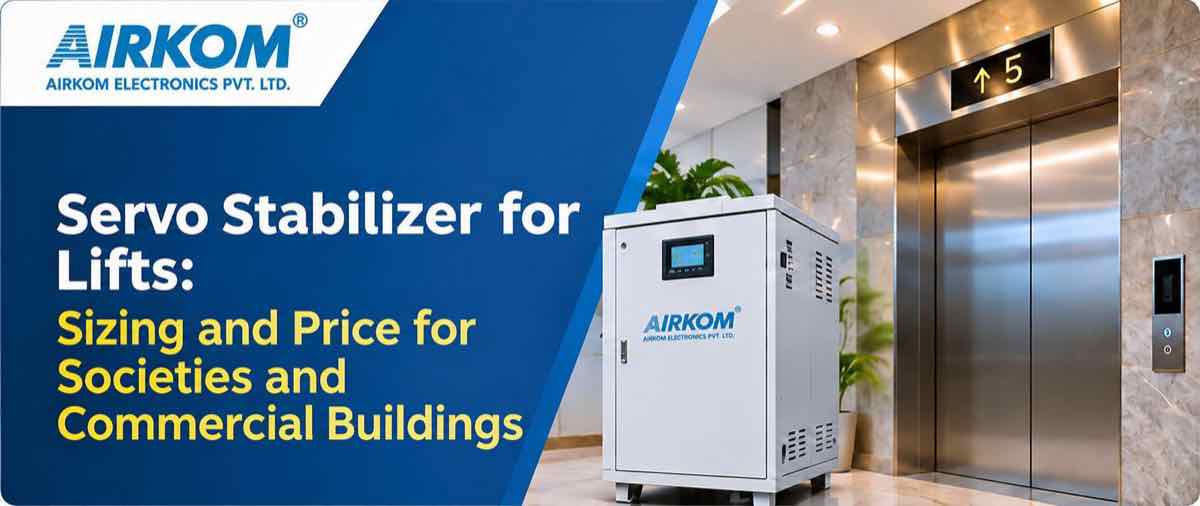
An 8-person lift typically needs a 15-20 kVA 3 phase servo stabilizer. But a stabilizer is not backup: to stop people getting trapped in a power cut you also need a Lift UPS. Here is how to size both.
In this articleShow
- Lift stabilizer sizing table (passenger, goods and hospital lifts)
- What low and high voltage do to a lift
- How to size a servo stabilizer for a lift
- A stabilizer is not backup: where a Lift UPS fits in
- Lift UPS system: how it works, backup time and sizing
- Servo stabilizer for lift price and Lift UPS price: what drives the cost
- Installation and AMC for housing societies
- Get the right lift protection for your building
- Frequently asked questions
Short answer: A typical 6–8 person passenger lift with a 5.5–7.5 kW motor needs a 15–20 kVA 3 phase servo stabilizer. A stabilizer protects the lift from voltage swings but does nothing in a power cut. To bring the lift to a floor or keep it running during an outage, you also need a Lift UPS. Most housing societies should budget for both.
Ask any society secretary about lift complaints and you will hear the same three things: the lift stops between floors, the controller card "went again", and the repair bill is higher than expected. Many of these come back to the power supply. Residential and commercial buildings often see low voltage in the evening peak, high voltage late at night, and short power cuts several times a month.
A lift has two separate power problems, and each one needs a different product:
- Voltage swings damage the VFD (variable frequency drive), controller and door operator. The fix is a servo voltage stabilizer.
- Power cuts trap people inside the car. The fix is a Lift UPS.
This guide shows how to size each one, when a society needs both, and what drives the price.
Lift stabilizer sizing table (passenger, goods and hospital lifts)
| Lift type | Typical motor rating | Suggested servo stabilizer (3 phase) | Suggested Lift UPS (for full running backup) |
|---|---|---|---|
| 4–6 person passenger lift | 3.7 – 5.5 kW (5 – 7.5 HP) | 10 – 15 kVA | 10 – 15 kVA |
| 8 person passenger lift | 5.5 – 7.5 kW (7.5 – 10 HP) | 15 – 20 kVA | 15 – 20 kVA |
| 10–13 person passenger lift | 7.5 – 11 kW (10 – 15 HP) | 20 – 30 kVA | 20 – 30 kVA |
| Hospital bed / stretcher lift | 7.5 – 15 kW | 25 – 40 kVA | 25 – 40 kVA (strongly recommended) |
| Goods lift (1–2 tonne) | 7.5 – 15 kW | 25 – 40 kVA | Optional; rescue-only backup often enough |
| Tower with 2–4 lifts on one feeder | Sum of motors | One central unit, 40 – 100 kVA | Central Lift UPS sized for the lifts that must run |
These are planning figures. Lift motors and drives vary by make (gearless, geared, MRL), so always check the controller panel nameplate or ask your lift contractor for the "rated input kVA" of the drive. If you are unsure, Airkom offers a free site load audit.
What low and high voltage do to a lift
Modern lifts use a VFD to start, run and stop the motor smoothly. The VFD, the controller card and the automatic door operator are all electronic, and they are the parts that fail when voltage misbehaves.
- VFD trips (low voltage). When supply drops, the drive sees DC bus undervoltage and stops the car, sometimes between floors. Passengers are stuck even though there is no power cut.
- Controller card failure (high voltage). Night-time overvoltage and switching surges stress the SMPS and logic boards. Controller cards are among the most frequently replaced, and most expensive, lift spares.
- Door faults. Door operators are sensitive to voltage. Low voltage causes slow or incomplete closing, repeated reopening and "door lock" errors.
- Motor heating. A motor run at under-voltage draws more current, which heats the windings and the brake coil and shortens their life.
- Single phasing. If one phase drops, a motor without protection can burn out. A good stabilizer cuts off the output on single phasing.
How to size a servo stabilizer for a lift
Sizing a servo stabilizer for lift duty is about the motor and drive, not the cabin size alone. A stabilizer for lift use must handle frequent starts, so it needs more headroom than a stabilizer feeding steady loads.
Passenger lift: size by persons or motor HP
Find the motor kW (or HP × 0.746). Divide by 0.8 to get kVA, then multiply by 2 to cover the starting current. VFD-driven lifts start smoothly, but the drive input still draws more at acceleration, and lifts start and stop many times an hour.
Example, 8 person lift with a 7.5 kW motor: 7.5 ÷ 0.8 = 9.4 kVA. Multiply by 2 and you get about 19 kVA, so a 20 kVA 3 phase servo stabilizer. If the car lighting, fan and controller are on the same feeder, 20 kVA still covers them.
Goods lift and hospital bed lift
Goods lifts carry heavier loads and often use larger geared motors, sometimes with star-delta or DOL starting in older installations. Size at 2–2.5 times the motor kVA. Hospital bed lifts are mission-critical, so size the stabilizer generously and always pair them with a Lift UPS.
One stabilizer for multiple lifts in a tower
For a tower with two to four lifts, one central 3 phase servo stabilizer for society use is usually cheaper and easier to maintain than one per lift. Lifts rarely all start at the same instant, so add up the running kVA of all lifts and multiply by 1.5 rather than 2. For example, two 8-person lifts at 9.4 kVA each come to 18.8 kVA. Multiplied by 1.5 that is about 28 kVA, so choose a 30 kVA central unit. Keep separate outgoing MCBs for each lift so a fault in one does not stop the other.
Airkom's Residential Servo Stabilizer (3 Phase, Air Cooled) is designed for housing complexes and elevators, with silent operation. For commercial buildings with heavier loads, the 3 Phase Servo Stabilizer (10–400 kVA) is the standard choice.
Need the exact rating? Send us your lift make, number of persons and motor kW, and we will recommend both the stabilizer and the Lift UPS. Request a quote or free site audit →
A stabilizer is not backup: where a Lift UPS fits in
This is the most common misunderstanding we see in society meetings. A servo stabilizer corrects voltage that is too high or too low. When the supply fails completely, the stabilizer has nothing to correct and the lift stops.
A DG set does not fully solve this either. Most DG sets take 10–30 seconds to start and change over, and the lift stops during that gap. Many society DG sets are also not sized to start lifts.
Airkom's Lift UPS is a 3 phase power backup system rated from 6 kVA to 400 kVA. It sits between the supply and the lift controller and takes over without a break when power fails.
Facility managers also call this an elevator UPS or simply a UPS for lift. Some buyers search for an online UPS for elevator use. Whatever the name, what matters is that it handles the motor's starting current and takes over the instant the supply drops.
| Servo stabilizer | Lift UPS | |
|---|---|---|
| Solves | High / low voltage, unbalanced phases | Power cuts and DG changeover gaps |
| Protects | VFD, controller card, door operator, motor | Passengers (no trapping) and the lift electronics |
| Works during a power cut? | No | Yes, for the battery backup time |
| Needs batteries? | No | Yes |
Lift UPS system: how it works, backup time and sizing
A Lift UPS stores energy in a battery bank. When the mains or DG fails, its inverter supplies 3 phase power to the lift without a break, so the car keeps moving. There are two ways to use it:
- Rescue mode: the UPS powers the lift only long enough to reach the nearest floor and open the doors. Battery requirement is small. This is the minimum every residential lift should have.
- Full running backup: the UPS keeps the lift in normal service for a set time, for example 30 minutes to a few hours. This needs a larger battery bank. It suits buildings with long or frequent outages, hospitals and senior-citizen housing.
Sizing the Lift UPS: match the UPS kVA to the stabilizer sizing (motor kVA × 2) so it can handle the starting current. Backup time then depends on the battery bank: the longer the backup, the larger the battery bank and the higher the cost. For a fair quote, tell the supplier the number of trips per hour you expect during an outage. A lift that runs continuously in a 20-floor tower uses much more energy than one in a 5-floor building.
Battery choice matters too. Sealed maintenance-free SMF batteries have a lower upfront cost. Lithium batteries cost more but take less space, recharge faster and last longer, which helps when outages come back to back.
Servo stabilizer for lift price and Lift UPS price: what drives the cost
Societies often receive quotes that are hard to compare. These are the factors that move the price:
- kVA rating of the stabilizer and the UPS. Oversizing by two steps adds real cost.
- Input voltage range of the stabilizer. Areas with deep evening sags need a wide-range model.
- Backup time of the Lift UPS. This is the battery bank, and it is often the largest single cost.
- Battery type: SMF vs lithium.
- One central unit vs one per lift.
- Installation: cabling from the meter room to the machine room, battery rack, ventilation.
- AMC: annual maintenance cost over 5 years.
Current price bands: Airkom provides up-to-date prices for lift stabilizers and Lift UPS systems on request, because cost depends heavily on backup time and battery choice. Share your lift details through the contact page or call +91 93238 63400 for a written quote.
Our advice to societies: do not buy the cheapest stabilizer and skip the UPS. A trapped resident costs the committee far more in complaints and liability than a rescue-mode Lift UPS costs to buy.
Installation and AMC for housing societies
A few practical points from installations:
- Install the stabilizer in the lift machine room or the meter room, not in a wet basement. Keep 0.5 m clearance for ventilation and service.
- Use the bypass switch only for maintenance. Running permanently on bypass removes all protection.
- Keep the stabilizer's output ON time delay (15 seconds as standard on Airkom units) so the lift restarts only after power has settled. This prevents repeated restarts during a flickering supply.
- Ask your lift contractor to confirm that the controller accepts a UPS supply. Most modern controllers do.
- Plan for battery replacement in the Lift UPS budget. Batteries are consumables.
Airkom offers Comprehensive AMC and Semi Comprehensive AMC plans for stabilizers and UPS systems, with periodic checks of the servo mechanism, carbon brush, battery health and protections. For a society, a comprehensive AMC makes budgeting predictable.
Get the right lift protection for your building
Airkom manufactures servo stabilizers and Lift UPS systems at Mahape, Navi Mumbai, for housing societies, builders, hospitals and commercial buildings. Send us your lift details (make, persons, motor kW, number of lifts) and we will recommend the combination and send a written quote.
View Lift UPS (6–400 kVA) → | Residential Servo Stabilizer → | Request a quote / free site audit →
Frequently asked questions
What kVA servo stabilizer is required for an 8-person lift?
Most 8-person passenger lifts use a 5.5–7.5 kW motor. At a 0.8 power factor with 2× allowance for starting, a 15–20 kVA 3 phase servo stabilizer is the right size. Confirm the exact motor rating from the lift controller nameplate.
Do lifts need a stabilizer if the building has a DG set?
Yes. A DG set only covers power cuts. It does not correct low or high voltage from the grid, which is what damages lift VFDs and controller cards. A DG set's own output can also fluctuate when other loads switch. The lift also stops during the 10–30 second DG changeover unless a Lift UPS is installed.
What is the difference between a lift stabilizer and a lift UPS?
A lift stabilizer corrects voltage that is too high or too low but stops working when power fails. A Lift UPS has batteries and an inverter that keep the lift running, or bring it to the nearest floor, during a power cut. A stabilizer protects the equipment; a Lift UPS protects the passengers.
How long can a Lift UPS run the lift during a power cut?
It depends on the battery bank. A rescue-mode setup only needs enough energy to reach the next floor and open the doors. A full-backup system can be designed to keep the lift in service for 30 minutes to several hours. Backup time is specified when ordering and directly affects the price.
What is the price of a lift UPS system?
Lift UPS price depends on the kVA rating, required backup time, battery type (SMF or lithium) and installation. Airkom's Lift UPS range covers 6–400 kVA in 3 phase. Share your lift details on the contact page for a current, itemised quote.
Can one stabilizer protect all the lifts in a building?
Yes. A central 3 phase servo stabilizer can feed two to four lifts through separate outgoing breakers. Size it at about 1.5 times the combined running kVA. This usually costs less than individual units and needs only one AMC.

Engineers at Airkom Electronics, makers of servo stabilizers, online UPS systems and power transformers at our plant in Mahape, Navi Mumbai. ISO 9001 and ISO 14001 certified.