





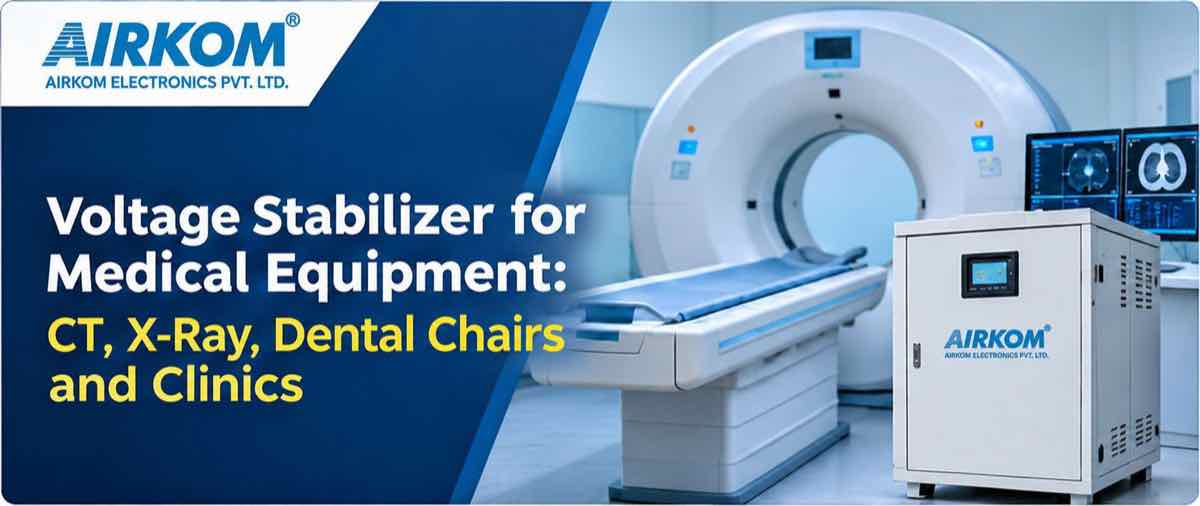
CT and X-ray machines need a fast-acting static stabilizer sized to their momentary load; dental chairs and clinic loads are well served by servo. A machine-by-machine guide for hospitals, diagnostic centres and clinics.
In this articleShow
- Machine-wise guide: which stabilizer for which medical equipment
- Why medical equipment fails on unstable voltage
- Static vs servo stabilizer for medical use
- How to size a stabilizer for medical equipment
- Stabilizer, UPS or both?
- Do you need an isolation transformer too?
- Price factors for medical stabilizers
- Questions to ask before you buy
- Protect your equipment with the right stabilizer
- Frequently asked questions
Short answer: Use a static (solid-state) stabilizer for CT scanners, X-ray machines and other diagnostic equipment that draw sudden heavy loads or need very fast correction. A servo stabilizer is a reliable, economical choice for steady loads such as dental chairs, lab analyzers and general clinic power. Always size from the equipment maker's power requirement sheet, not from a guess.
Medical equipment is expensive and service visits are slow. It is also judged by results: a blurred image, a failed exposure or a lab analyzer that resets mid-run all cost money and patient trust. In many Indian cities and towns, supply voltage at a clinic or diagnostic centre can move 15–20% between morning and evening. Medical OEMs know this. That is why their installation manuals specify a voltage tolerance and often state that damage from unstable power is not covered by warranty.
This guide is for biomedical engineers, diagnostic centre owners, radiologists and dentists who need to pick the right stabilizer for a specific machine. It covers static vs servo, a machine-by-machine table, how to read the OEM sheet, and when you need a UPS as well.
Machine-wise guide: which stabilizer for which medical equipment
| Equipment | Load behaviour | Recommended stabilizer type | Typical phase / kVA band* |
|---|---|---|---|
| CT scanner | Heavy, sudden load during scan; sensitive gantry and detector electronics | Static, 3 phase | 3 phase; as per OEM, commonly in the higher tens to 100+ kVA |
| X-ray (fixed / DR / CR) | Short, high momentary draw during exposure | Static (preferred) or fast servo | 1 or 3 phase depending on generator rating; as per OEM |
| MRI support systems (chiller, compressor, HVAC) | Motor loads, continuous | Servo, 3 phase (oil cooled for large units) | 3 phase; sized to chiller/compressor rating |
| Ultrasound / echo / Doppler | Small, steady, very sensitive | Static 1 phase (often with online UPS) | 1 phase; 1 – 3 kVA |
| Dental chair + compressor + suction | Small steady load plus motor starts | Servo 1 phase (or 3 phase for multi-chair) | 1 phase 3 – 5 kVA per chair; 3 phase for a multi-chair clinic |
| Lab analyzers (CBC, biochemistry, immunoassay) | Steady, sensitive, long runs | Static 1 phase + online UPS | 1 phase; 1 – 5 kVA |
| OT / ICU equipment | Mixed sensitive loads, zero tolerance for interruption | Static + online UPS | As per load schedule |
| Whole clinic / small nursing home | Mixed: AC, lights, equipment | Servo 3 phase central unit, with dedicated static units for imaging | 3 phase; 15 – 100 kVA depending on size |
*kVA bands are a starting point only. Imaging equipment ratings vary widely by model and manufacturer. The OEM's site-planning or power requirement document is the final reference. Airkom's engineers can read it for you as part of a free site load audit.
In short: a stabilizer for CT machine rooms should be static and 3 phase. A stabilizer for X ray machine installations should be static (or a fast servo), sized to the exposure load. A stabilizer for ultrasound machine use is a small static unit, often paired with an online UPS. A servo stabilizer for dental chair circuits is the economical choice. A stabilizer for clinic-wide protection is usually a central 3 phase servo. Larger hospitals typically install a static voltage stabilizer for hospital imaging departments and a servo stabilizer for general loads.
Why medical equipment fails on unstable voltage
- X-ray tube and generator stress. The high-voltage generator in an X-ray or CT system expects a stable input. Low voltage during exposure can cause under-exposed images, exposure errors or aborted exposures. Repeated stress shortens the life of the generator and tube, which are the most expensive parts of the system.
- Image quality errors. Detector electronics, ultrasound transducers and processing boards produce artefacts and noise when supply is unstable.
- Board failures. Power supply boards and control PCBs fail from repeated overvoltage and switching surges, typically after night-time high voltage or DG changeovers.
- Resets and data loss. Lab analyzers that reset mid-run waste reagents and samples and delay reports.
- Warranty and service disputes. OEMs frequently check input voltage logs after a failure. If the site had no voltage correction, warranty claims can be rejected.
Static vs servo stabilizer for medical use
Both types regulate voltage. The difference is how fast they correct it and how they do it.
| Factor | Static stabilizer | Servo stabilizer |
|---|---|---|
| Technology | IGBT / DSC-based PWM, fully solid-state | Servo motor driving a variac and buck-boost transformer |
| Correction speed | Almost instantaneous (Airkom 3 phase: ≥ 4000 V/sec; 1 phase: around 50 μsec) | Airkom 1 phase: 35 V/sec average; 3 phase: 70 V/sec average |
| Moving parts | None, so near-zero maintenance | Motor and carbon brush need periodic service |
| Waveform distortion | Nil (Airkom 3 phase static) | Nil under normal operation |
| Surge protection | Inbuilt (Class 2 on 3 phase; Class B+C on 1 phase) | Add separately if needed |
| Best for | CT, X-ray, ultrasound, analyzers, OT / ICU | Dental chairs, chillers, HVAC, whole-clinic supply |
| Cost | Higher | Lower |
Our view: for imaging equipment, pay for static. The cost difference is small compared to one generator or detector repair. For dental chairs, compressors and general clinic power, a servo stabilizer is reliable and better value. Both Airkom ranges deliver ±1% output regulation and better than 98% efficiency.
For a deeper technical comparison, see our servo vs static stabilizer guide.
How to size a stabilizer for medical equipment
Step 1: Get the OEM power requirement sheet
Every CT, X-ray and MRI vendor provides a site-planning guide. Look for:
- Supply: 1 phase 230 V or 3 phase 415 V, and the permitted tolerance (often ±10%).
- Continuous (standby) load in kVA. This is what the system draws when idle or between scans.
- Momentary (peak) load in kVA. This is what it draws during exposure or scanning, often several times the continuous figure.
- Maximum line impedance / voltage drop allowed at the equipment terminals.
Step 2: Size for the momentary load, not the continuous load
This is where most mistakes happen. A CT scanner might show a modest continuous load but a much larger momentary load. If you size the stabilizer for the continuous figure, voltage at the machine collapses during the scan. Size the stabilizer to handle the momentary kVA, and make sure the cable from the stabilizer is short and heavy enough to stay within the OEM's voltage-drop limit.
Step 3: Add the auxiliaries
Add the console PC, injector, chiller, room AC (if on the same feed) and lighting. For a whole-clinic stabilizer, list every load and apply a diversity factor, because not all equipment runs at once.
Example: dental clinic with three chairs
Each chair with its suction and light runs at about 1–1.5 kVA. Add a 1.5–2 kVA compressor that starts direct-on-line, plus an RVG/X-ray unit and a PC. A clinic like this is usually best served by one 10–15 kVA 3 phase servo stabilizer or by separate 1 phase servo units per circuit, with a small static stabilizer or online UPS dedicated to the dental X-ray. Confirm the figures against your actual equipment.
Have the OEM sheet? Send it to us and Airkom's engineers will recommend the type and kVA. See Static Voltage Stabilizer (3 Phase, 10–400 kVA) or request a quote and free site load audit.
Stabilizer, UPS or both?
A stabilizer corrects voltage. It does nothing in a power cut. Ask yourself what happens to the patient and the machine if power fails mid-procedure:
- Ultrasound, lab analyzers, CBC machines, PACS / reporting PCs: these need an online UPS. Online double-conversion UPS also regulates voltage, so a separate stabilizer is often unnecessary for these small loads. See our guide on online UPS for servers, labs and diagnostic machines.
- CT and large X-ray: full UPS backup for the whole system is costly. Usually a static stabilizer covers the system, with a UPS for the console, computers and gantry electronics so that data is not lost. Follow the OEM's recommendation.
- OT and ICU: online UPS for critical equipment is standard, often with a static stabilizer upstream.
- Dental chairs and general clinic: a stabilizer is usually enough; add a small UPS for the PC and X-ray sensor.
Do you need an isolation transformer too?
Often, yes, for imaging and lab equipment. A stabilizer fixes voltage level. It does not fix neutral-to-earth voltage, which comes from poor earthing and causes noise in images and random errors. It also does not fix electrical noise from other equipment on the same supply. Many OEMs specify a maximum neutral-earth voltage. Airkom's Critical Power Quality Transformer provides isolation and a clean neutral at the equipment. For background, read why ultra isolation transformers matter for sensitive diagnostics.
Price factors for medical stabilizers
- Static vs servo: static costs more but corrects instantly and needs almost no maintenance.
- kVA rating: driven by the momentary load, so read the OEM sheet carefully.
- 1 phase vs 3 phase.
- Input voltage range: wider range costs more but is essential in areas with deep sags.
- Isolation transformer and surge protection if required.
- Installation and AMC.
Current price bands: Airkom provides up-to-date prices for medical-grade static and servo stabilizers on request, based on your equipment and site. Share your OEM power sheet through the contact page or call +91 93238 63400.
Questions to ask before you buy
- Is the stabilizer sized for the momentary load, and is that stated in the quotation?
- What is the correction speed and response time, in writing?
- Does it correct each phase independently (unbalanced load correction)?
- Which protections are included: overvoltage / undervoltage cut-off, overload, short circuit, single phasing, surge?
- Is there a bypass switch for maintenance?
- Is there a time delay on output restart after a power cut?
- What AMC and response time is offered in your city?
Protect your equipment with the right stabilizer
Airkom designs and manufactures static and servo stabilizers, isolation transformers and online UPS systems at Mahape, Navi Mumbai, for hospitals, diagnostic centres and clinics. Send us your equipment list or OEM power requirement sheet and we will recommend the right protection with a written quote.
Static Stabilizer 3 Phase (10–400 kVA) → | Static Stabilizer 1 Phase (1–20 kVA) → | Servo Stabilizer 1 Phase (1–20 kVA) | Pharma & Healthcare | Request a quote →
Frequently asked questions
Which stabilizer is best for an X-ray machine?
A static (solid-state) stabilizer is best for X-ray machines. Exposure creates a sudden, heavy load, and a static stabilizer corrects voltage almost instantly with no moving parts. Size it for the momentary (exposure) kVA given in the X-ray manufacturer's power requirement sheet, not the standby load.
Is a static stabilizer better than a servo for a CT scanner?
Yes. A CT scanner draws large, rapid load changes during scanning, and its detector and gantry electronics are sensitive. A 3 phase static stabilizer corrects within milliseconds and adds no waveform distortion, which suits CT better than a servo stabilizer. Servo stabilizers remain a good choice for the CT room's chiller and HVAC.
What kVA stabilizer does a dental clinic need?
A single dental chair with suction and compressor is usually served by a 3–5 kVA 1 phase servo stabilizer. A clinic with two to four chairs, a compressor and dental X-ray is often better served by one 10–15 kVA 3 phase servo stabilizer, with a small static stabilizer or online UPS for the X-ray and computers. Confirm against your equipment ratings.
Does a medical stabilizer need an isolation transformer?
Often, yes, for imaging and lab equipment. A stabilizer controls voltage level but does not remove neutral-to-earth voltage or electrical noise. Many medical OEMs specify a maximum neutral-earth voltage, and an isolation transformer such as Airkom's Critical Power Quality Transformer gives a clean, isolated supply.
Can one stabilizer protect a whole clinic?
Yes, a central 3 phase servo stabilizer can protect a whole clinic's general load, including dental chairs, AC and lighting. Imaging equipment such as X-ray and CT should still have its own dedicated static stabilizer, sized to its momentary load, so that other loads switching on do not affect it.
Do I need a UPS as well as a stabilizer for an ultrasound machine?
For ultrasound and lab analyzers, an online UPS is usually the better single choice, because it regulates voltage and also keeps the machine running during a power cut. A separate stabilizer is generally not needed for these small loads if a properly sized online UPS is installed.

Engineers at Airkom Electronics, makers of servo stabilizers, online UPS systems and power transformers at our plant in Mahape, Navi Mumbai. ISO 9001 and ISO 14001 certified.